Чтение текста вслух · 54 задания
- Задание №39№39Лёгкое
Task 1. Imagine that you are preparing a project with your friend. You have found some interesting material for the presentation and you want to read…
Чтение вслух
- Задание №39№39Среднее
Task 1. Imagine that you are preparing a project with your friend. You have found some interesting material for the presentation and you want to read…
Чтение вслух
- Задание №39№39Среднее
Task 1. Imagine that you are preparing a project with your friend. You have found some interesting material for the presentation and you want to read…
Чтение вслух
- Задание №39№39Лёгкое
Task 1. Imagine that you are preparing a project with your friend. You have found some interesting material for the presentation and you want to read…
Чтение вслух
- Задание №39№39Лёгкое
Task 1. Imagine that you are preparing a project with your friend. You have found some interesting material for the presentation and you want to read…
Чтение вслух
- Задание №39№39Сложное
Task 1. Imagine that you are preparing a project with your friend. You have found some interesting material for the presentation and you want to read…
Чтение вслух
- Задание №39№39Сложное
Task 1. Imagine that you are preparing a project with your friend. You have found some interesting material for the presentation and you want to read…
Чтение вслух
- Задание №39№39Лёгкое
Task 1. Imagine that you are preparing a project with your friend. You have found some interesting material for the presentation and you want to read…
Чтение вслух
- Задание №39№39Среднее
Task 1. Imagine that you are preparing a project with your friend. You have found some interesting material for the presentation and you want to read…
Чтение вслух
- Задание №39№39Лёгкое
Task 1. Imagine that you are preparing a project with your friend. You have found some interesting material for the presentation and you want to read…
Чтение вслух
- Задание №39№39Среднее
Task 1. Imagine that you are preparing a project with your friend. You have found some interesting material for the presentation and you want to read…
Чтение вслух
- Задание №39№39Среднее
Task 1. Imagine that you are preparing a project with your friend. You have found some interesting material for the presentation and you want to read…
Чтение вслух
 Task 1. Imagine that you are preparing a project with your friend. You have found some interesting material for the presentation and you want to read this text to your friend. You have 1.5 minutes to read the text silently, then be ready to read it out aloud. You will not have more than 1.5 minutes to read it.
Ответ на это задание — устный: его записывают голосом.
Решение
Текст для чтения.
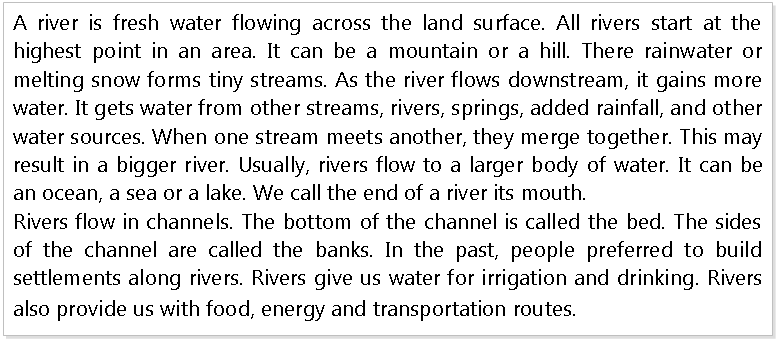
A river is fresh water flowing across the land surface. All rivers start at the highest point in an area. It can be a mountain or a hill. There rainwater or melting snow forms tiny streams. As the river flows downstream, it gains more water. It gets water from other streams, rivers, springs, added rainfall, and other water sources. When one stream meets another, they merge together. This may result in a bigger river. Usually, rivers flow to a larger body of water. It can be an ocean, a sea or a lake. We call the end of a river its mouth.
Rivers flow in channels. The bottom of the channel is called the bed. The sides of the channel are called the banks. In the past, people preferred to build settlements along rivers. Rivers give us water for irrigation and drinking. Rivers also provide us with food, energy and transportation routes.
Трудные для произношения слова. surface [ˈsɜːfɪs], downstream [ˌdaʊnˈstriːm], streams [striːmz], merge [mɜːdʒ], channels [ˈtʃænlz], settlements [ˈsetlmənts], irrigation [ˌɪrɪˈɡeɪʃn], transportation [ˌtrænspɔːˈteɪʃn].
На что обратить внимание. Перечисление «other streams, rivers, springs, added rainfall, and other water sources» — пять элементов подряд, ровная интонация на всех, кроме последнего. Параллельная конструкция «The bottom… is called the bed. The sides… are called the banks.» произносится с одинаковым интонационным рисунком в обоих предложениях. Вводные «Usually,» и «In the past,» отделяются паузой. Слово «mouth» (устье) в конце первого абзаца — [maʊθ]; отличие от «mouse» [maʊs] не в дифтонге (он в обоих словах одинаковый), а в последнем согласном: θ вместо s.