Задание №38 — Письменная речь
Написать письменное высказывание
Задание будет подставлено в форму проверки
Выберите только ОДНО из двух предложенных заданий — 38.1 или 38.2 — и выполните его согласно данному плану. В ответе на задание 38 числительные пишите цифрами.
Задание 38.1
Imagine that you are doing a project on how Zetlanders help raise awareness about the environment. You have found some data on the subject – the results of a survey conducted among Zetlanders (see the table below) .
Comment on the survey data and give your opinion on the subject of the project.
The survey question: How do you help raise awareness about the environment? Choose one option | |
Options | Number of respondents (%) |
Participate in local clean-up events | 37 |
Reduce my own waste | 20 |
Support environmental organisations | 16 |
Educate friends and family | 14 |
Share information online | 13 |
Write200–250 words.
Use the following plan:
–make an opening statement on the subject of the project;
–select and report 2–3 facts;
–make 1–2 comparisons where relevant and give your comments;
–outline a problem related to neglecting environmental issues and suggest a way of solving it;
–conclude by giving and explaining your opinion on the importance of protecting our planetʼs ecology.
Задание 38.2
Imagine that you are doing a project on school clubs. You have found some data on the subject – the results of a survey conducted among Zetland school students (see the pie chart below) .
Comment on the survey data and give your opinion on the subject of the project.
The survey question:
Why do you refuse to attend school clubs?
Chooseoneoption
Write200–250 words.
Use the following plan:
–make an opening statement on the subject of the project;
–select and report 2–3 facts;
–make 1–2 comparisons where relevant and give your comments;
–outline a problem related to school club attendance and suggest a way of solving it;
–conclude by giving and explaining your opinion on the importance of attending school clubs.
Решение
Что нужно сделать. Задание альтернативное: 38.1 или 38.2, ученик выбирает один вариант. Оба построены по единому плану из пяти пунктов: вступление о теме проекта и об опросе; 2–3 факта с цифрами; 1–2 сравнения с комментарием; проблема строго по формулировке пункта 4 плана; мнение автора строго по вопросу пункта 5 плана. Объём — 200–250 слов.
Вариант 38.1 (table). Тема проекта — как жители Зетландии повышают осведомлённость об экологии. Источник данных — table, опрос среди: Zetlanders. Проблема пренебрежения экологическими вопросами (пункт 4 плана); мнение о важности защиты экологии планеты (пункт 5 плана).
Данные таблицы. Вопрос опроса: «How do you help raise awareness about the environment?». «Participate in local clean-up events» — 37%; «Reduce my own waste» — 20%; «Support environmental organisations» — 16%; «Educate friends and family» — 14%; «Share information online» — 13%.
Возможный ответ (38.1).
I am currently doing a school project that investigates the ways Zetlanders contribute to protecting the environment. For this project, I found the results of a survey among Zetlanders, in which every respondent chose one option that described their contribution.
The table shows that 37 percent of the people surveyed "participate in local clean-up events", and 20 percent simply "reduce my own waste". Meanwhile, 16 percent try to "support environmental organisations" financially or as volunteers.
Comparing the two remaining options is revealing: 14 percent prefer to "educate friends and family", whereas only 13 percent choose to "share information online". The near-identical figures for these two options show that Zetlanders trust face-to-face persuasion and online posts almost equally.
Neglecting environmental issues often happens simply because people doubt that their own small effort changes anything on a larger scale. Showing the concrete results of local clean-up events, such as the exact amount of rubbish collected, could convince more residents that their contribution genuinely counts. Local authorities could publish these figures publicly after every event to keep residents motivated.
In conclusion, I strongly believe that protecting our planet's ecology deserves to be a genuine priority for everyone, because countless small daily choices, once made by millions of people together, can noticeably slow down the environmental damage we are currently causing.
Вариант 38.2 (pie chart). Тема проекта — школьные кружки. Источник данных — pie chart, опрос среди: Zetland school students. Проблема, связанная с посещением школьных кружков (пункт 4 плана); мнение о важности посещения школьных кружков (пункт 5 плана).
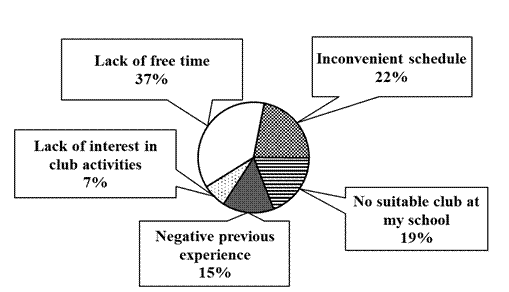
Данные диаграммы. Вопрос опроса: «Why do you refuse to attend school clubs?». «Lack of free time» — 37%; «Inconvenient schedule» — 22%; «No suitable club at my school» — 19%; «Negative previous experience» — 15%; «Lack of interest in club activities» — 7%.
Возможный ответ (38.2).
I am currently working on a school project that explores why some Zetland students stay away from school clubs. To find this out, I found a pie chart with the results of a survey conducted among Zetland school students who do not attend any club.
According to the data, 37 percent of the students questioned mentioned "lack of free time" as their main reason, while 22 percent complained about an "inconvenient schedule". Another 19 percent said there was simply "no suitable club at my school".
It is interesting to compare the two least common answers. Only 15 percent referred to a "negative previous experience", and just 7 percent admitted a genuine "lack of interest in club activities". Organisational reasons clearly outweigh a real dislike of activities.
School club timetables are frequently fixed without ever asking the students who are supposed to attend them, which leaves many with no suitable option. Letting students vote on club schedules at the start of each term would solve this rather easily. Teachers could then adjust the timetable each term based directly on that feedback.
To conclude, I am firmly convinced that taking part in a school club matters, because it helps teenagers build new skills and form friendships well beyond their usual classroom circle, something that ordinary lessons rarely manage to offer on their own.