Задание №38 — Письменная речь
Написать письменное высказывание
Задание будет подставлено в форму проверки
Выберите только ОДНО из двух предложенных заданий — 38.1 или 38.2 — и выполните его согласно данному плану. В ответе на задание 38 числительные пишите цифрами.
Задание 38.1
Imagine that you are doing a project on why many young Zetlanders choose to major in agricultural sciences. You have found some data on the subject – the results of a survey (see the table below) .
Comment on the survey data and give your opinion on the subject of the project.
The survey question: Why have you chosen to major in agricultural sciences? | |
Reasons | Number of respondents (%) |
Environmental concerns | 37 |
Wish to feed everyone | 28 |
Research opportunities | 20 |
Job stability | 9 |
Practical skills development | 6 |
Write 200–250 words.
Use the following plan:
–make an opening statement on the subject of the project;
–select and report 2–3 facts;
–make 1–2 comparisons where relevant and give your comments;
– outline a problem that can arise with studying agricultural sciences and suggest a way of solving it;
–conclude by giving and explaining your opinion on the importance of
agricultural professionals in today’s world.
Задание 38.2
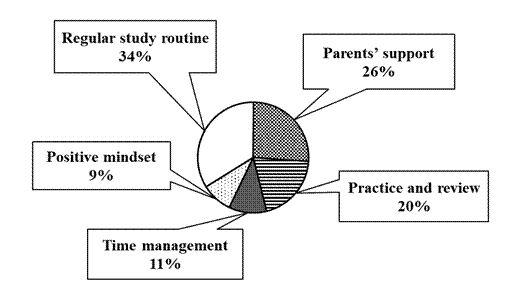
Imagine that you are doing a project on Zetland teenagers’ preparation for final exams. You have found some data on the subject – the results of a survey (see the pie chart below) .
Comment on the survey data and give your opinion on the subject of the project.
The survey question:
What helped you the most in preparing for final exams?
Write 200–250 words.
Use the following plan:
–make an opening statement on the subject of the project;
–select and report 2–3 facts;
–make 1–2 comparisons where relevant and give your comments;
– outline a problem that can arise with preparing for final exams and suggest a way of solving it;
–conclude by giving and explaining your opinion on how to prepare for final exams.
Решение
Что нужно сделать. Задание альтернативное: 38.1 или 38.2, ученик выбирает один вариант. Оба построены по единому плану из пяти пунктов: вступление о теме проекта и об опросе; 2–3 факта с цифрами; 1–2 сравнения с комментарием; проблема строго по формулировке пункта 4 плана; мнение автора строго по вопросу пункта 5 плана. Объём — 200–250 слов.
Вариант 38.1 (table). Тема проекта — почему многие молодые жители Зетландии выбирают агрономию. Источник данных — table, опрос среди: young Zetlanders who study this subject at university. Проблема, связанная с изучением агронауки (пункт 4 плана); мнение о важности профессии агронома в современном мире (пункт 5 плана).
Данные таблицы. Вопрос опроса: «Why have you chosen to major in agricultural sciences?». «Environmental concerns» — 37%; «Wish to feed everyone» — 28%; «Research opportunities» — 20%; «Job stability» — 9%; «Practical skills development» — 6%.
Возможный ответ (38.1).
I am currently doing a school project that looks at what draws young Zetlanders towards agricultural sciences. To collect data, I found the results of a survey conducted among young Zetlanders who study this subject at university.
The table shows that 37 percent of the students questioned chose this major because of "environmental concerns", while 28 percent were driven by a "wish to feed everyone". A further 20 percent were attracted by "research opportunities".
If we compare the two least common reasons, only 9 percent mentioned "job stability", and merely 6 percent picked "practical skills development". Idealistic and scientific motives clearly matter more than purely practical career reasons. This wide gap suggests that a sense of purpose, rather than job security or hands-on training, is what mainly draws students to this field.
Long periods of fieldwork away from campus make it difficult for agricultural science students to hold down a part-time job alongside their studies. Paid research assistant positions connected directly to that same fieldwork would solve the difficulty rather elegantly. Universities could actively help students find such positions through closer partnerships with local farms.
In conclusion, I am convinced that agricultural professionals are extremely important in today's world, because they are ultimately the people who will have to feed a rapidly growing population while still protecting the very land that makes farming possible in the first place.
Вариант 38.2 (pie chart). Тема проекта — подготовка подростков Зетландии к выпускным экзаменам. Источник данных — pie chart, опрос среди: Zetland teenagers who had recently taken their final exams. Проблема подготовки к выпускным экзаменам (пункт 4 плана); мнение о том, как лучше готовиться к выпускным экзаменам (пункт 5 плана).
Данные диаграммы. Вопрос опроса: «What helped you the most in preparing for final exams?». «Regular study routine» — 34%; «Parents' support» — 26%; «Practice and review» — 20%; «Time management» — 11%; «Positive mindset» — 9%.
Возможный ответ (38.2).
I am currently working on a school project that explores how Zetland teenagers get ready for their final exams. To research this, I found a pie chart with the results of a survey conducted among Zetland teenagers who had recently taken their final exams.
The data reveal that 34 percent of the respondents named a "regular study routine" as the thing that helped them most, while 26 percent pointed to "parents' support". A further 20 percent relied mainly on "practice and review".
Comparing the two least mentioned factors is interesting: only 11 percent chose "time management", and just 9 percent picked a "positive mindset". Consistent daily habits and family encouragement clearly matter more than attitude alone.
Trying to revise every subject at the very last moment causes enormous stress for teenagers approaching their final exams. Drawing up a realistic revision timetable weeks ahead, with subjects divided into manageable daily portions, prevents this kind of panic. Short breaks built into that timetable also help students avoid burning out before the exams even begin.
To conclude, in my opinion, the best way to prepare for final exams is to combine a steady, realistic study routine with regular practice tests, because this approach genuinely builds both solid knowledge and lasting confidence long before the exam day finally arrives.