Задание №38 — Письменная речь
Написать письменное высказывание
Задание будет подставлено в форму проверки
Выберите только ОДНО из двух предложенных заданий — 38.1 или 38.2 — и выполните его согласно данному плану. В ответе на задание 38 числительные пишите цифрами.
Задание 38.1
Imagine that you are doing a project on why many young Zetlanders choose to major in the humanities. You have found some data on the subject – the results of a survey (see the table below) .
Comment on the survey data and give your opinion on the subject of the project.
The survey question: Why have you chosen to major in the humanities? | |
Reasons | Number of respondents (%) |
Love for creativity | 37 |
Interesting subjects | 28 |
Public significance | 20 |
Variety of jobs upon graduation | 9 |
Personal fulfilment | 6 |
Write 200–250 words.
Use the following plan:
–make an opening statement on the subject of the project;
–select and report 2–3 facts;
–make 1–2 comparisons where relevant and give your comments;
– outline a problem that can arise with studying the humanities and suggest a way of solving it;
–conclude by giving and explaining your opinion on the importance of
choosing the right profession.
Задание 38.2
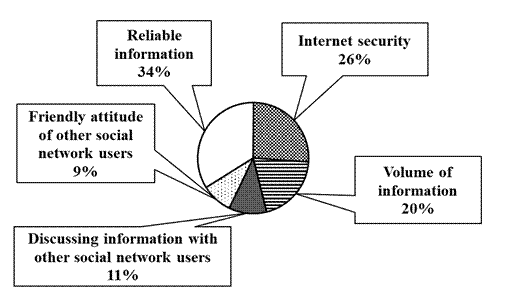
Imagine that you are doing a project on Zetlanders’ priorities in reading and discussing the news in social networks. You have found some data on the subject – the results of a survey (see the pie chart below) .
Comment on the survey data and give your opinion on the subject of the project.
The survey question:
What is your priority in reading and discussing the news in social networks?
Write 200–250 words.
Use the following plan:
–make an opening statement on the subject of the project;
–select and report 2–3 facts;
–make 1–2 comparisons where relevant and give your comments;
– outline a problem that can arise with reading and discussing the news in social networks and suggest a way of solving it;
– conclude by giving and explaining your opinion on whether one should trust the news from social media.
Решение
Что нужно сделать. Задание альтернативное: 38.1 или 38.2, ученик выбирает один вариант. Оба построены по единому плану из пяти пунктов: вступление о теме проекта и об опросе; 2–3 факта с цифрами; 1–2 сравнения с комментарием; проблема строго по формулировке пункта 4 плана; мнение автора строго по вопросу пункта 5 плана. Объём — 200–250 слов.
Вариант 38.1 (table). Тема проекта — почему многие молодые жители Зетландии выбирают гуманитарные специальности. Источник данных — table, опрос среди: young Zetlanders who study humanities subjects at university. Проблема, связанная с изучением гуманитарных наук (пункт 4 плана); мнение о важности выбора правильной профессии (пункт 5 плана).
Данные таблицы. Вопрос опроса: «Why have you chosen to major in the humanities?». «Love for creativity» — 37%; «Interesting subjects» — 28%; «Public significance» — 20%; «Variety of jobs upon graduation» — 9%; «Personal fulfilment» — 6%.
Возможный ответ (38.1).
I am currently doing a school project that looks at what attracts young Zetlanders to the humanities. To gather data, I found the results of a survey conducted among young Zetlanders who study humanities subjects at university.
The table shows that 37 percent of the students questioned chose this field because of their "love for creativity", while 28 percent were drawn by "interesting subjects". A further 20 percent value its "public significance". These figures suggest that personal passion, rather than career planning, drives most of these choices.
If we compare the two least common reasons, only 9 percent mentioned a "variety of jobs upon graduation", and merely 6 percent picked "personal fulfilment". Creative and intellectual motives clearly matter more than practical career considerations. The steady decline from the top answer down to the last one suggests that creative fulfilment, rather than career planning, is what draws most students towards this field.
Some people wrongly assume that a humanities degree offers far fewer job prospects than a technical one. Universities could easily correct this by explaining more clearly the wide range of careers their graduates actually go on to have. Career fairs specifically for humanities students could also help correct this common misunderstanding.
In conclusion, I am convinced that choosing the right profession is of great importance, because young people who study something they love tend to succeed and stay motivated.
Вариант 38.2 (pie chart). Тема проекта — приоритеты жителей Зетландии в чтении новостей в соцсетях. Источник данных — pie chart, опрос среди: Zetlanders. Проблема обсуждения новостей в соцсетях (пункт 4 плана); мнение о том, стоит ли доверять новостям из соцсетей (пункт 5 плана).
Данные диаграммы. Вопрос опроса: «What is your priority in reading and discussing the news in social networks?». «Reliable information» — 34%; «Internet security» — 26%; «Volume of information» — 20%; «Discussing information with other social network users» — 11%; «Friendly attitude of other social network users» — 9%.
Возможный ответ (38.2).
I am currently working on a school project that explores what matters to Zetlanders when they follow the news on social media. To research this, I found a pie chart with the results of a survey conducted among Zetlanders.
According to the data, 34 percent of the respondents value "reliable information" above everything else, while 26 percent care most about "internet security". A further 20 percent pay attention to the "volume of information" available.
Comparing the two least common priorities is revealing: only 11 percent chose "discussing information with other social network users", and just 9 percent picked a "friendly attitude of other social network users". Quality and safety clearly matter more than the social side. The considerable gap between the leading answer and the last one suggests that Zetlanders judge the value of online news mainly by how trustworthy it seems, rather than by how much of it they can find.
False or exaggerated stories about public figures can spread through social networks long before anyone stops to check the facts. Following only verified official accounts when searching for such news would prevent most of this confusion. Fact-checking websites can also be extremely useful before sharing anything that sounds surprising.
To conclude, in my opinion, one should certainly not blindly trust the news found on social media, because, unlike professional journalism, posts shared there are rarely checked properly before they are published for everyone to see.