Задание №38 — Письменная речь
Написать письменное высказывание
Задание будет подставлено в форму проверки
Выберите только ОДНО из двух предложенных заданий — 38.1 или 38.2 — и выполните его согласно данному плану. В ответе на задание 38 числительные пишите цифрами.
Задание 38.1
Imagine that you are doing a project “Family budget: what Zetlanders spend their money on”. You have found some data on the subject – the results of a survey (see the table below) .
Comment on the survey data and give your opinion on the subject of the project.
Item of expenditure | % of family budget |
|---|---|
Housing | 35 |
Food | 25 |
Medical aid | 17 |
Entertainment | 16 |
Other | 7 |
Write200–250 words.
Use the following plan:
–make an opening statement on the subject of the project;
–select and report 2–3 facts;
–make 1–2 comparisons where relevant and give your comments;
– outline a problem that can arise with one’s family budgetand suggest a way of solving it;
– conclude by giving and explaining your opinion on the importance of budgeting carefully.
Задание 38.2
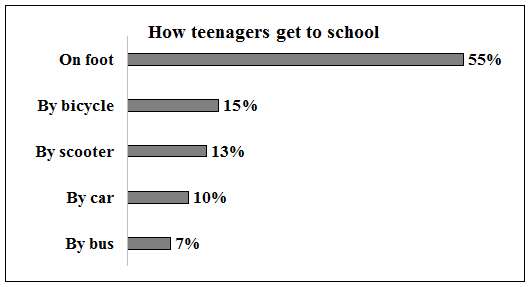
Imagine that you are doing a project on how teenagers get to school in Zetland. You have found some data on the subject the results of a survey (see the diagram below) .
Comment on the survey data and give your opinion on the subject of the project.
Write 200250 words.
Use the following plan:
make an opening statement on the subject of the project;
select and report 2–3 facts;
make 1–2 comparisons where relevant and give your comments;
outline a problem that can arise with getting to school and suggest a way of solving it;
conclude by giving and explaining your opinion on the importance of living close to school for teenagers.
Решение
Что нужно сделать. Задание альтернативное: 38.1 или 38.2, ученик выбирает один вариант. Оба построены по единому плану из пяти пунктов: вступление о теме проекта и об опросе; 2–3 факта с цифрами; 1–2 сравнения с комментарием; проблема строго по формулировке пункта 4 плана; мнение автора строго по вопросу пункта 5 плана. Объём — 200–250 слов.
Вариант 38.1 (table). Тема проекта — проект «Family budget: what Zetlanders spend their money on». Источник данных — table, опрос среди: Zetlanders. Проблема семейного бюджета (пункт 4 плана); мнение о важности бережливого планирования бюджета (пункт 5 плана).
Данные таблицы. Вопрос опроса: «Family budget distribution». «Housing» — 35%; «Food» — 25%; «Medical aid» — 17%; «Entertainment» — 16%; «Other» — 7%.
Возможный ответ (38.1).
I am currently working on a school project called "Family budget: what Zetlanders spend their money on". To collect data, I found the results of an opinion poll conducted among Zetlanders about how they distribute their monthly income.
The table shows that "housing" takes up the largest share of the family budget, at 35 percent, while "food" accounts for 25 percent. A further 17 percent of the budget goes towards "medical aid".
If we compare the two smallest shares, "entertainment" takes up 16 percent, and the "other" category accounts for just 7 percent. Zetlanders clearly spend more on leisure than on all remaining smaller expenses combined. The considerable gap between housing and every other category suggests that, for most Zetland families, a stable home remains by far the largest single expense each month.
Overspending on entertainment often leaves too little in the family budget for essential costs such as housing or medical aid. Setting a fixed monthly limit for entertainment and tracking every expense with a simple budgeting app keeps spending firmly under control. Reviewing the whole budget together as a family once a month also helps keep everyone accountable.
In conclusion, in my opinion, budgeting carefully is of great importance for every family, because it allows essential needs such as housing and medical care to be covered first, well before the stress of unexpected financial difficulties can arise later in the month.
Вариант 38.2 (bar chart). Тема проекта — как подростки добираются до школы в Зетландии. Источник данных — bar chart, опрос среди: teenagers in Zetland. Проблема, связанная с дорогой до школы (пункт 4 плана); мнение о важности проживания недалеко от школы (пункт 5 плана).
Данные диаграммы. Вопрос опроса: «How teenagers get to school». «On foot» — 55%; «By bicycle» — 15%; «By scooter» — 13%; «By car» — 10%; «By bus» — 7%.
Возможный ответ (38.2).
I am currently doing a school project that explores how Zetland teenagers usually travel to school. To research this, I found a bar chart with the results of an opinion poll conducted among teenagers in Zetland about their usual way of getting there.
The data reveal that 55 percent of the respondents get to school "on foot", while 15 percent travel "by bicycle". A further 13 percent choose to go "by scooter". These figures suggest that most teenagers still rely on their own two feet to get to school.
Comparing the two least common ways is interesting: only 10 percent get to school "by car", and just 7 percent travel "by bus". Most Zetland teenagers clearly rely on their own effort rather than on motor transport.
Heavy morning traffic near school gates can make walking or cycling there feel genuinely unsafe. Creating dedicated pedestrian and cycling paths that avoid the busiest roads around every school would remove this danger. Encouraging carpooling among neighbouring families could also reduce some of that traffic considerably.
To conclude, in my opinion, staying close to school genuinely matters a great deal for teenagers, because it saves valuable time every single morning and makes walking, a healthy, free and reliable way to travel, a realistic daily option for far more students.