Задание №38 — Письменная речь
Написать письменное высказывание
Задание будет подставлено в форму проверки
Выберите только ОДНО из двух предложенных заданий — 38.1 или 38.2 — и выполните его согласно данному плану. В ответе на задание 38 числительные пишите цифрами.
Задание 38.1
Imagine that you are doing a project on why some Zetlanders refuse to attend music schools. You have found some data on the subject –
the results of a survey (see the table below) .
Comment on the survey data and give your opinion on
the subject of the project.
The opinion poll question: Why do you refuse to attend a music school? | |
Reasons | Number of respondents (%) |
No fast result | 29 |
Time-consuming | 23 |
Not interested in music | 19 |
Far from home | 15 |
No money for a quality instrument | 14 |
Write 200–250 words.
Use the following plan:
–make an opening statement on the subject of the project;
–select and report 2–3 facts;
–make 1–2 comparisons where relevant and give your comments;
– outline a problem that can arise with learning to play a musical instrument and suggest a way of solving it;
–conclude by giving and explaining your opinion on whether one should be able to play a musical instrument.
Задание 38.2
Imagine that you are doing a project called “Zetland: riding a bicycle around the city”. You have found some data on the subject the results of a survey (see the pie chart below) .
Comment on the survey data and give your opinion on
the subject of the project.
The opinion poll question:
What is the key factor for you when deciding
to ride a bicycle around the city?
Write 200250 words.
Use the following plan:
make an opening statement on the subject of the project;
select and report 2–3 facts;
make 12 comparisons where relevant and give your comments;
outline a problem that one can face when riding a bike around the city and suggest a way of solving it;
conclude by giving and explaining your opinion on whether a bicycle is a convenient means of transport.
Решение
Что нужно сделать. Задание альтернативное: 38.1 или 38.2, ученик выбирает один вариант. Оба построены по единому плану из пяти пунктов: вступление о теме проекта и об опросе; 2–3 факта с цифрами; 1–2 сравнения с комментарием; проблема строго по формулировке пункта 4 плана; мнение автора строго по вопросу пункта 5 плана. Объём — 200–250 слов.
Вариант 38.1 (table). Тема проекта — почему часть жителей Зетландии отказывается посещать музыкальную школу. Источник данных — table, опрос среди: Zetlanders who chose not to attend a music school. Проблема обучения игре на музыкальном инструменте (пункт 4 плана); мнение о том, нужно ли уметь играть на инструменте (пункт 5 плана).
Данные таблицы. Вопрос опроса: «Why do you refuse to attend a music school?». «No fast result» — 29%; «Time-consuming» — 23%; «Not interested in music» — 19%; «Far from home» — 15%; «No money for a quality instrument» — 14%.
Возможный ответ (38.1).
I am currently doing a school project that looks at the reasons some Zetlanders decide against attending a music school. To collect data, I found the results of an opinion poll conducted among Zetlanders who chose not to attend one.
The table shows that 29 percent of the respondents refused because they expected "no fast result", while 23 percent felt learning music was simply "time-consuming". A further 19 percent admitted they were "not interested in music" at all.
If we compare the two least common reasons, only 15 percent said the school was "far from home", and merely 14 percent mentioned "no money for a quality instrument". A lack of patience clearly discourages people more than practical obstacles. The steady decline across all five answers suggests that emotional and practical barriers together, rather than any single obstacle, keep many Zetlanders away from music lessons.
Slow early progress discourages many beginners long before they reach a level they can actually enjoy. Setting small, achievable goals, such as one short piece learned every month, makes that progress feel visible far sooner. A patient, encouraging teacher can also make an enormous difference during those early, difficult weeks.
In conclusion, in my opinion, everyone should ideally be able to play a musical instrument at some level, because doing so develops discipline, patience and creativity that clearly benefit a person far beyond the world of music itself.
Вариант 38.2 (pie chart). Тема проекта — проект «Zetland: riding a bicycle around the city». Источник данных — pie chart, опрос среди: Zetlanders. Проблема езды на велосипеде по городу (пункт 4 плана); мнение о том, удобен ли велосипед как транспорт (пункт 5 плана).
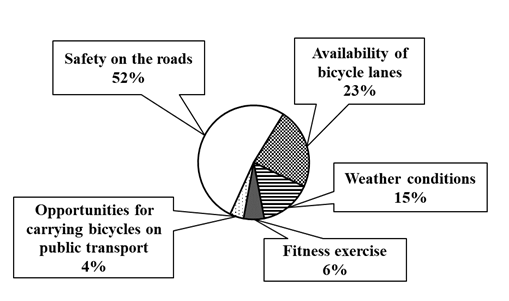
Данные диаграммы. Вопрос опроса: «What is the key factor for you when deciding to ride a bicycle around the city?». «Safety on the roads» — 52%; «Availability of bicycle lanes» — 23%; «Weather conditions» — 15%; «Fitness exercise» — 6%; «Opportunities for carrying bicycles on public transport» — 4%.
Возможный ответ (38.2).
I am currently working on a school project called "Zetland: riding a bicycle around the city". To research this, I found a pie chart with the results of an opinion poll conducted among Zetlanders about what influences their decision to cycle.
The data reveal that 52 percent of the respondents named "safety on the roads" as the key factor, while 23 percent chose the "availability of bicycle lanes". A further 15 percent pay close attention to "weather conditions".
Comparing the two least common factors is interesting: only 6 percent mentioned "fitness exercise", and just 4 percent picked "opportunities for carrying bicycles on public transport". Road conditions clearly matter more than fitness or transport convenience. The considerable gap between the leading answer and the rest suggests that, for most Zetlanders, feeling physically safe on the road matters far more than any other single factor.
Heavy traffic makes cycling next to cars genuinely dangerous in many parts of the city. Building separated bicycle lanes that keep cyclists completely apart from motor vehicles would remove most of that danger. Better street lighting in the evenings would also encourage far more people to feel safe cycling after dark.
To conclude, in my opinion, a bicycle is indeed a genuinely convenient means of getting around, because it is cheap, environmentally friendly and, once proper infrastructure finally exists everywhere, considerably safer than many people currently seem to believe.